Part 2 of this project focuses on the aftermath of debuting in traditional publishing, including the ways it gets better. (Part 1, Why Is Debuting So Hard? is here)

How to Survive Debut Author Stress:
Recovery & Recommendations
Click here to go back to Part 1 (the Challenges of Launching). To recap, our big questions were:
- What unusual OR common events befall or even derail debuts?
- Which specific ways does debut stress affect authors, short and long-term?
- How do authors recover … or what prevents them from doing so?
Prerelease was awful to get through but I think it helped clarify for me […] while that may be an overall negative for some, it’s helped me solidify the business side of my mindset in a way that I think will benefit me going forward. If they’re going to treat me like a number on a spreadsheet, I can do the same to them, and no one is going to fight as hard as I will to get to where I want to go. Overall I feel better equipped to navigate this industry than I did pre-debut.
“Selena,” author
- OVERALL RECOVERY
- POST-DEBUT CHALLENGES AND GROWTH
Lasting growth
Lasting challenges
‘Petty’ thoughts - RECOVERY STRATEGIES
Commonly discussed strategies
Creative solutions - MARGINALIZATION
More on stereotype threat
Helping across differences - MESSAGES FROM THE OTHER SIDE
- CLOSING COMMENTS
- RESOURCES
I. OVERALL RECOVERY

Yay, everybody recovered at least a little! except for one lone author. Notably, that individual (who rated improvement as “‘Not at all/worsened'”) had rated their overall debut experience “A little” stressful and peak “Somewhat” stressful, so there was likely less to recover from. Day-to-day publishing maintains some baseline stress.
The average and median level of recovery was “Somewhat,” reflecting few outliers. Most people experience a substantial amount of relief.
Finished my second book despite my first book not selling well (basically overcame second book syndrome). [I am] less excited about writing in general, think a lot about quitting.
“Mai,” author
Does time heal? If the peak anxiety was exceptionally bad, does that mean you’ll be ‘scarred’ and struggle to recover?
I ran the data, and it suggests there is no evidence or connection. Regardless of how much time had passed, the writers might have recovered about the same (perhaps because the question was framed in terms of ‘debut stress,’ but respondents might have been thinking about overall ‘career maintenance stress’). Whether overall stress was extreme or low, the writers’ recovery was the same (or affected by something else).
II. POST-DEBUT CHALLENGES AND GROWTH
LASTING GROWTH

These questions asked about the long-term positive or negative fallout of their debut.
On the upside, every respondent reported significant boosts in publishing equivalent of ‘post-traumatic growth.’ Almost everyone gained in “Self-esteem or self-knowledge (positive),” “Industry knowledge,” “Friends/community/support,” “Resilience/grit,” and “Improved agency/boundary setting.”
Further, the majority described Ongoing benefits months or years later.
Most “Not applicable” responses were clarified as respondents having good self-esteem, support, grit, or coping strategies before publishing.
Several folx acknowledged their new strengths are inconsistent. One writer said, “Re: agency/boundary-setting, I put “ongoing,” but this is absolutely something I have struggled with and continue to struggle with. Asking for things and stating my needs is always scary, but luckily, publishing gives me a lot of regular opportunities to practice this.” Another noted, “Despite claims I would be better about boundary setting and protecting my time I still say yes to every opportunity (promo, event, sub call) that comes my way.”
To be human is to be inconsistent. Growth in all things is nonlinear. Examples include pubescent growth spurts, plants and seasons, and pandemic era hair loss. Please be self-compassionate and open to incremental change.
The above results may be biased toward the positive. Those for whom debut was totally overwhelming or defeating likely left the industry, and therefore they would NOT have taken the survey.
LASTING CHALLENGES
Now for the soul-crushing part, I asked about four major areas of stress-induced loss: “Writing drive/productivity,” “Ability to trust others,” “Self-esteem,” and “Resilience.” No further definitions were offered in the survey, so authors made interpretations.
- 93% (31) respondents experienced at least one ‘loss,’ the great majority having subsided
- 58% (19) is still experiencing at least one “Ongoing” loss (i.e., 48% have recovered from all losses at time of survey), and
- 24% (8) respondents with MORE than one “Ongoing” area of damage, but
- Only 3% (1) respondent reported “Ongoing” loss in all 4 areas, at <1 year since debut
Note that the individual who experienced “Ongoing” loss everywhere is a DIFFERENT respondent from the one who described “Not at all/worsened” recovery. In other words, within this sample, specific losses did not totally prevent overall recovery, and difficulty overall recovering did not reflect loss in every way.
Worth noting, many authors expressed they had concurrent life problems unrelated to their debut (see Stress Levels and Factors) that may have exacerbated these losses. Future analyses may take a closer look.
‘PETTY’ THOUGHTS
I debuted at the same time as [a viral book] and in the build up to [another]. […] It took me a long time to make myself see sense. Everyone on social media is shouting as loud as they can about their successes and hiding the huge pile of shit that’s behind their successes.
“Tess,” author
In the free writing section, people also mentioned emotions and thoughts often considered petty or hurtful to others. “Comparison” and “jealous[y]” was both implied or explicitly named many times, especially where marketing budget (correlated with advances) and overall success. One respondent mentioned feeling dismissive and condescending (“superior complex”) toward peers who were “way happier and grateful” than themself, apparently interpreting the others as naive. Fortunately, respondents considered these ‘inside thoughts,’ knowing better than to share them in public or take them out on other authors.
Apart from real considerations of systemic inequity, these types of judgments are usually ‘not personal’ or realistic, consisting of intrusive thoughts and post hoc rationalizations of emotional pain. The general recommendation is to manage them with your preferred stress coping (see Recovery Strategies), venting to non-debut networks, and accepting ‘flawed’ reactions without worrying too much about deep moral implications.
III. RECOVERY STRATEGIES
These tools are presented while braced for exasperation, as most will be painfully familiar. The hope is, that seeing them endorsed by fellow writers will invite reflection; these are not trite memes thrown out by rote, invalidating the real systemic issues in publishing and healthcare, but sincere recommendations from within the community.
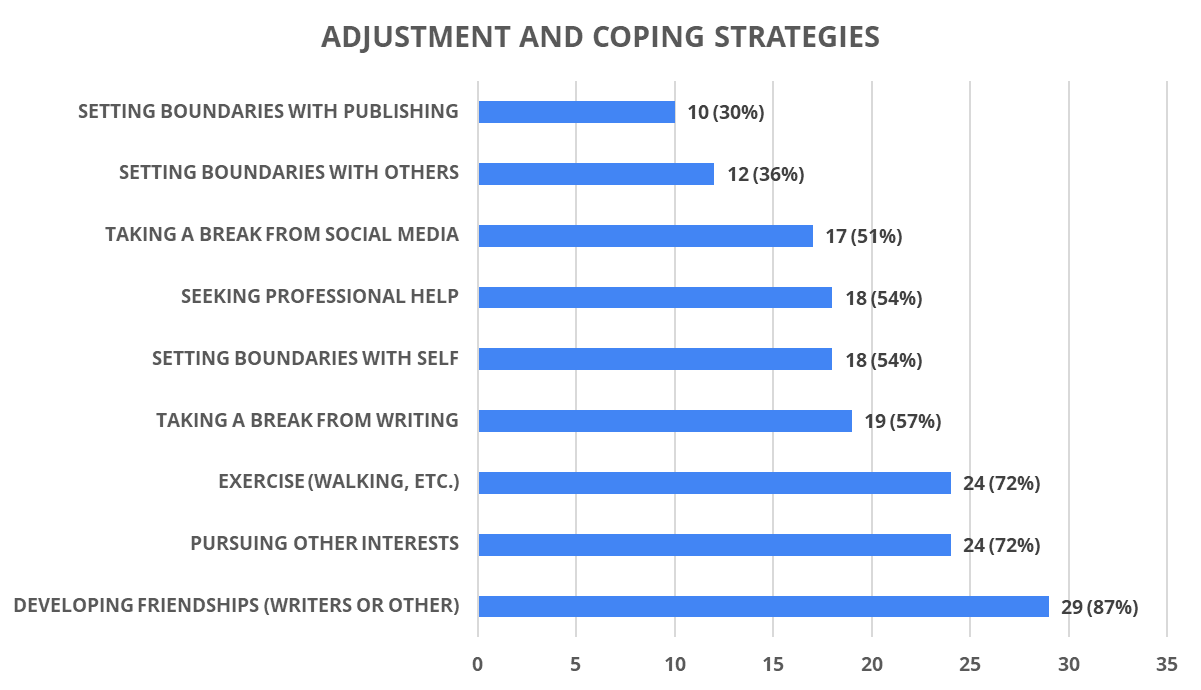
COMMONLY DISCUSSED STRATEGIES
- Setting boundaries with publishing: One interpretation was, “Making the decision to never work with that publisher again felt empowering and like I was protecting myself”
- Setting boundaries with others: Potentially including friends and family
- Taking a break from social media: Whether to limit exposure to others’ activity OR suspend one’s own marketing. “Taking time away from social media,” “Reducing social media time helped a lot too,” “focus less on the outer circle, the “tribe” of the Romancelandia on social media, for example,” “I only do social media and promotion I enjoy, and I limit to make sure I have time to write”
- Seeking professional help: Mentorship, psychiatric medication, psychotherapy, etc. “really helpful to have a mentor to talk me through the debut experience and dealing with second book syndrome,” “a mentorship program and […] a chat group where I’d heard some really great, frank conversations about how debut can affect mental health,” “pharmaceutical antidepressants [are] the only thing that pulled me out of massive burnout,” “Lexapro for anxiety,” “Therapy helped me reframe my self-concept and understand that the success of others/the fickle expectations of the publishing industry didn’t mean anything negative about me,” “low-cost therapy […] with a focus on anxiety and my particular compulsions and how to question and dismantle negative thought spirals. […] the strategies I learned still help today.”
- Setting boundaries with self: may include identifying and balancing on problems and changing/cutting back on one’s own behavior (such as checking inbox). On a positive note, some authors successfully separated business vs. creative vs. community aspects of their career: “I love writing! I consider it mostly separate from the publication deal.”
- Taking a break from writing: Minimum 1 week suspension. Respondents recommended, “Taking a break. I really needed it. It’s been critical for me to give myself time to recharge the well,” and “occasional time away from the publishing industry.”
- Exercise: Formal and informal included. Taking walks was VERY popular, and “I’m a gym rat;” “boxing. You have to be fully present or you get punched in da face lol;” one described exercise as “a hobby [you can] 1) can succeed at without relying on anyone else, and 2) isn’t done for Daddy Capitalism.”
- Pursuing other interests: Some even included reading, i.e., “other genres and older books where my perception of them is less conflated with the publicity they received,” “[…] [reading is] my most enjoyed activity and when I feel the most like myself. (ESPECIALLY IF I CRY […]),” but also “petting my dog,” “sell[ing] handmade crafts at a local market, and the monotony of making stuff helped put things in perspective,” “other hobbies (crafting, gardening, gaming etc) […] keeping me from obsessing over publishing news”
- Developing friendships (writers or other): May include curating sub-groups within groups. “[…] cultivating friendships with other debuting authors from a smaller group than the main Slack (i.e., Pitch Wars),” “Making friends who know NOTHING about publishing,” “I don’t think this industry would be survivable without support groups/networks. […] I had lovely people around me to keep me afloat.” Another felt better from, “Doing writing sprints with trusted friends.”
An incomplete list of mentioned ways to find community: writing conferences (some may be free online), workshops, mentorships (both virtual or in person), and social media (including BlueSky and even Reddit). Be aware that common wisdom is to share LESS openly in larger or more public servers/groups.
Finishing my contract and gaining distance from the books has helped the most. I was able to fully integrate the positives […] how much I had gown […] also gaining perspective on the negatives, and letting those wounds heal or scar. My creativity and joy in writing was completely destroyed, and I made it worse by trying to force myself to write through a misguided sense that I needed to maintain career momentum and have another book out ASAP. The correct move was to give myself more time and grace, and focus on refilling the creative well with other media and activities.
“Leyla,” author
CREATIVE SOLUTIONS
- Leverage responsive literary agent with unresponsive editors: “Any questions I had, I could pass through [my agent], and let him deal with figuring out how to get a useful answer out of someone.”
- Pay attention to reader connections and positive feedback: “Focusing on the readers and their wonderful reactions to the book. Meeting and speaking with them and other wonderful writers […]” — positivity passes and praise from beta readers fit here too!
- Delegating social media (or devices): “Having close friends to take over my social media when it started feeling particularly detrimental to my mental health”
- Making your own Discord server (may also apply to Wikias, collaging, etc.): One author shared they made a completely private Discord server, with channels dedicated to advice/writing process observations, positive events, venting, etc. They reported this structured safe space was key to getting them out of an emotional crisis.
- Reflective writing exercises (may include journaling, etc.): A respondent shared they keep a “checklist” for “Publishing Dreams,” with a note at the top of the document that dreams are ‘fully out of [their] control.’ The content included “big, impossible-level stuff,” but also “regular” milestones like finishing drafts, a personal reminder even these are “worthy of treasuring.” Even negative experiences were included, like “first one-star review, first time getting tagged in a negative review) as a reminder […] readers who won’t like my books is just part of the process.” The respondent reported this helped them get a relatively balanced perspective.
- Self-defining private vs. public persona: Possibly part of ‘setting boundaries with self,’ strategizing about this, anything from separate social media accounts to limiting publishing discussion to certain social circles. One author said: “On a funnier note, as a musician/actor/idol fan, I do think having a model for […] strong sense of “this is the public persona, this is the private self” really helps.”
A few remarks on therapy stood out and have been included to offer guidance on how to address issues with mental health providers who may not be familiar with publishing.
I take heart whenever I talk to my friend […] she reminds me that for every story I write, there is someone out there who will read it and have their life changed. I won’t ever know about it, in the same way that I haven’t been able to tell every author I’ve read how much their work meant to me, but I trust [my friend] and I believe her. My words have saved someone’s life. I’m not religious, but I have faith in that.
Curtis C. Chen, author
IV. MARGINALIZATION
No specific information or advice was solicited about the authors’ experiences of marginalization, but authors mentioned safety concerns with publicity and inequity in publisher support due to systemic inequality. Unfortunately, both seem likely to worsen given the political context of 2025 especially in the United States, but forewarning and solidarity may help publicity venues and street teams plan around safety and problem-solving.
‘Jon,’ a trans person, was surprised by the need to publically perform vulnerable, personal aspects of his life to market his book. When he debuted, safety concerns surrounded putting himself on such display, and as of 2025, it’s likely more dangerous. He urges the need for publicity plans that don’t demand authors stake themselves in personal essays, appearances, and interviews. However, given the industry has increasingly opted to exploit author labor rather than spend money, he’s cynical this will ever happen.
As a BIPOC author debuting, I feel like there’s a lot of pressure to get it right. I also know my books content will have to carry my success since I will not be receiving the most robust marketing plan so I feel like there is extra pressure to make the work as best as possible not just for my standards but to push boundaries for opportunities that wouldn’t otherwise be available to me unless I prove my book has what it takes.
“Yasmine,” Author
MORE ON STEREOTYPE THREAT
Thus far, existing mindset interventions have proven effective only for marginalized people; members of the majority don’t seem tangibly affected. Everything from one’s name (or pen name) to physical appearance can disclose identity, and a decade of research suggests marginalized people are aware of negative stereotypes of their group and experience concerns about ‘proving stereotypes true.’ This is called stereotype threat.
In 2016, Pennington et al. conducted a review of literature about this, finding support for increased “anxiety, negative thinking, and mind-wandering” and that ‘stereotype-threatened’ individuals “may be motivated to disconfirm negative stereotypes, which can have a paradoxical effect of hampering performance.” The team acknowledged different social groups are likely affected in different ways, speculating “distinct mechanisms” are at play.
HELPING ACROSS DIFFERENCES
Comprehensive discussion is beyond the scope of this project, but it’s encouraged to have discussions about how to support each other across and within marginalized groups. On an ‘individual,’ ‘informal’ level, this may involve advocating for or uplifting yourself and others when opportunity arises, and simply sharing experiences and coping strategies especially with those who share your marginalization. Even if you are personally of different demographics or not marginalized, you can introduce diverse authors to each other!
The industry still needs initiatives to bring about systemic change, whether through awareness campaigns or negotiation efforts by organizations or influential individuals to set different trends/examples. As of time of time of posting, the Author’s Guild and SFWA’s Contracts Committee are such organizations (see more Resources), and the seminal antitrust case preventing the PRH/S&S merger may be an example of influential events (with influential publishing figures acting to protecting ‘midlist’ authors, including marginalized people).
V. MESSAGES FROM THE OTHER SIDE
Care from within the community pulled from short answers, presented without further commentary.
It’s okay to take breaks and have seasons where you are more creative and productive and times where you don’t need to write.
“Zan,” Author
If I can say one thing to debuts, it’d be: You’d be [amazed] at the number of things you will stop caring about! Your star rating on Goodreads. The number of adds you have on Goodreads. What blurbs you get, if any. Trade reviews. Best-of lists. Most anticipated lists.
“Gale,” Author
But if I could say a second thing: please do not feel any pressure to promote your book until you have a cover and preorder links. Seriously. I don’t promote my books until 2-3 months before they release now, unless there’s something I really, genuinely want to post. This has helped SO MUCH.
I can’t recommend [therapy] highly enough for everyone, even if you don’t think you have any heavy trauma or acute, immediate problems you need to deal with–we are all living in a world that is more than we can bear, and it is a goddamn power move to ask someone else for help. Be vulnerable. Admit you need to change. Figure out what the fuck you want out of this one and only life that we all get, and get busy living.
Curtis C. Chen, Author
VI. CLOSING COMMENTS
Portia Elan (HOMEBOUND, 2026) kindly wrote this summary of basic “survival kit” takeaways for the full text (lightly edited by me):
- Knowing what to expect (even “worst case scenarios”) helps writers protect themselves
- No matter how strange your debut seemed, the majority of experiences are shared
- It’s healthiest to focus on goals within your control and on connecting with your community
- You will (most likely) recover from the stress, maybe even within a few months
- The strategies for dealing with stress are the good old standbys, not glamorous but effective, the top 5 being:
- Socializing inside AND outside the publishing community
- Pursuing other interests (pets, crafting, video games, gardening, etc.)
- Exercise (of all kinds, even walking, dancing, etc.)
- Taking a break from writing/related activities for at least one week
- Setting boundaries with yourself
If these responses are to be believed, no matter how bad the stress, authors heal. At worst, they recover from the overall stress, but still have trouble with writing productivity, trust, self-esteem or resiliency; alternatively, people still have problems, but generally feel better anyway.
Community both inside and outside writing is incredibly important! Exercise, hobbies, and even love of literature itself can be sources of comfort and strength. Mentorship, medicine, and therapy can be transformative, and boundaries are different for everyone.
I came up with this project in January 2025, right after the new administration took office in the United States. ‘Someone should do something’ turned into ‘I can do something;’ a sentiment that dozens of other authors apparently agreed with, especially Tina, who threw her full support behind this and adjacent projects. This work is modest in scope, but we found it worth doing. If you benefited, please pay it forward to your communities.
Further analyses may be made available over the next few months.
Thanks so much to everyone who took the survey! Many responses were crafted with such meticulous attention to detail and compassion that, hopefully, comes through on this page and gives hope to future debuts.
VII. RESOURCES
Here is a list of pro-author resources. These are not endorsements, only recommendations from trusted friends and ‘the wisdom of the crowd.’