Anything you care about is going to cause stress, and traditionally publishing your first book is notoriously bizarre and isolating. Part 1 of this project explores how. (Part 2 here)

How to Survive Debut Author Stress:
Why Is This So Hard?
The goal here is to make stress coping easier and more powerful by:
- Normalizing challenges (yes, even the ones that don’t seem ‘normal’)
- Sharing how other authors got through it (bloodied but sometimes even empowered)
- Reevaluate and remind of common strategies with real anecdotes (direct quotes)–and share new ones!
- Broaden views of a publishing career as a journey (with inevitable ups and downs); not a destination, and you are not alone along the way
- Putting it all in one place
The big questions were:
- What unusual OR common events befall or even derail debuts?
- Which specific ways does debut stress affect authors, short and long-term?
- How do authors recover … or what prevents them from doing so?
Many of the recovery strategies focus on individual abilities, but publishing can and should become better on a systemic level, at least for those of us without private jets. Hopefully, these findings can offer guidance for that too.
This work is based on Stanford University studies in other settings (e.g., colleges). Interventions (assessment and plans) for problems with ‘belongingness’ only benefited marginalized people, likely due to challenges like stereotype threat (see the Marginalization section). If you are NOT a DEI believer, I dunno what to tell you. However, unlike colleges and universities, publishing is a uniquely small and opaque industry, and this information may benefit all authors and their teams regardless of majority status or disadvantages.
One thing that helped a lot was just hearing from other authors and realizing that almost all of the worries I had about debut were ones that fellow writers shared. I’d also listened to a podcast that talked about how debut dissatisfaction and crisis can sometimes be traced back to authors conflating dreams (things they hope might happen) with goals (things they can actually take concrete, measurable steps toward achieving), and that really helped with how I viewed debut.
“Selena,” author
- SURVEY SAMPLE
- TWO DEBUT OVERVIEWS
- STRESS LEVELS AND FACTORS
‘Unusual’ situations
Commonly discussed situations - INDUSTRY TRANSPARENCY ISSUES
- SPECIFIC IMPACTS ON FUNCTIONING
Thought patterns
Day-to-day activities
I. SURVEY SAMPLE
36 authors completed a survey, recruited from Victoria and T.A. Chan’s networks and social media (mostly Instagram). Including uncompleted surveys, the total was 44 (81% response rate–amazing! ✨). All were volunteers. Three (3) individuals were pre-debut authors, omitted from the graphs but included in discussion.
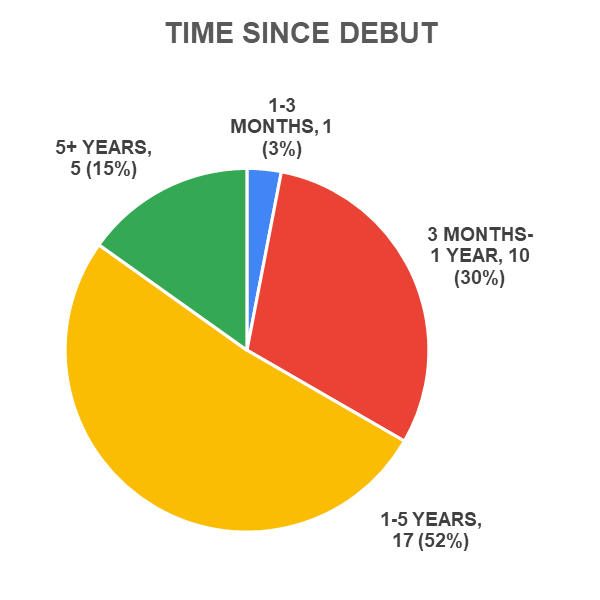
The 33 respondents disclosed how long ago they debuted (as of February or March 2025). Likely, the ‘debuted 1-5 years ago’ category was so large (17 people, 52%) due to the comparatively long time range AND their acute sympathy from recent experiences.
No general demographic information was requested, for privacy reasons. However, over 60% of the 44 original invitees were marginalized at least one way, and more than 3 members were drawn from most subgroups (e.g., trans or genderqueer, Black, Asian, neurodivergent, etc.). Some did report they are NOT marginalized. At least 11% were cisgender men.
Publishing statistics were not gathered. However, ONLY fiction novel authors were surveyed, and all of them have stayed in publishing (not retired). Invitations were accepted by 44 writers from all age categories (kid lit, adult), several genres (romance, speculative or sci-fi/fantasy/horror, historical, women’s fiction, etc.), various publisher sizes (medium-sized presses, big 5, etc.), Bestseller history, and advances sizes (up to ‘six figures,’ or auctions). I estimate most respondents were ‘mid list.’
The sample DOES NOT accurately represent demographic or other data for all published authors, so AVOID drawing global conclusions (but consider running bigger studies!). Note, many aliases below were created by the researcher.
In other words, someone similar to you likely took the survey.
II. TWO DEBUT OVERVIEWS
JUNE’S STORY

June’s debut was within the last five years with a major (‘big five’) publisher, who gave her a six figure advance. She was over the moon and seized the opportunity to become a full-time author. However, the editing process was delayed by the publisher and the publication date remained unchanged. This put massive pressure on edits and when her editor left publishing, her book was orphaned, leaving it without a champion. Her marketing team were great but were stretched with other titles and overwork. Performing her own publicity (social media) crushed her and, before learning she should avoid GoodReads, rude reviewers shocked her. She even regretted writing the book.
I couldn’t function! The worst was not being able to believe people would do as they said and when they said they’d do it.
June Bug (Anonymous), author
June experienced near-constant, disabling stress (“Very” intense overall, “Extreme” at peak) and suffered every stress symptom you could think of. As she tried to anticipate the next thing that would go wrong, panic attacks hit. She blamed herself for setbacks, believed she ‘didn’t belong,’ compared herself to more successful authors, lost her appetite, fought irritation and struggled to take care of her home and family. Despite positive trade reviews and reader feedback, she found herself picking apart every compliment for hidden meanings or implied criticism.
Despite this, June has bounced back in every way–she regained resilience, self-esteem, and though it took a bit longer, even her ability to trust others. Though she doesn’t write as steadily as before, it’s coming back. The post-‘traumatic’ growth has been astounding: she has more agency, sets better boundaries, sees herself as having a self-described “thicker skin” (grit) and more knowledgeable both about herself and the industry. A psychiatrist found a medication that worked wonders for anxiety. Even years after her debut, a new, additional friend group, with writers at similar points in their careers, helped restore faith in the human element of publishing, giving her a place to vent and get advice. She is much more optimistic about publishing these days and has more book launches to look forward to.
Other strategies that helped June were: firm boundaries (with herself and those outside publishing), taking week (or longer) social media/writing ‘world’ breaks, and professional help. Her determination not to accept unhealthy deadlines continues today. She advocates for taking long walks, sometimes with family and sometimes alone. It doesn’t hurt to have a cute dog or two.
SAMWISE’S STORY
Samwise debuted within the last five years with an independent publisher that seemed to have a solid reputation, and was paid an advance considered a ‘nice deal.’ After years in the querying trenches, he was ecstatic. Unfortunately, soon after signing, his acquiring editor began missing one deadline after another, causing downstream problems that ultimately delayed his sequel by a year. However, even for his first book, his editor’s enthusiasm didn’t line up with their actions—for example, the initial book cover proposal was poorly done, corners cut clearly to save money, and the book wasn’t being promoted the way other titles from the publisher were.
Through the whole process, Samwise was somewhat stressed, but at peak, stress was extreme. While his editor was often prompt in responding to emails, the information provided was either inaccurate or misleading. The main problem, he felt, was that the publisher over-promised to keep him happy, creating “false expectations” about distribution and marketing. That being said, he acknowledged perhaps there were slightly more ‘behind the scenes’ efforts than he saw.
Publishers need to learn to treat their authors like adults, which means being honest about what the author will or won’t get in terms of distribution, marketing, etc.
Samwise (Anonymous), author
Samwise had a lot of friends and resources in publishing, but still struggled with negative thoughts and grief. He ‘somewhat’ believed setbacks were mostly his fault, and greatly felt he didn’t belong. Luckily, comparing himself to more successful authors was less of a problem. Taking care of his health got tough, and he found himself withdrawing and slipping up at home and work. Success felt outside of his control, and he felt like he was “watching [his] writing career fail.”
In the years since his debut, Samwise has recovered a little. He still doesn’t feel as tough or confident as he used to be, and his trust for publishing professionals has taken a marked hit. However, he recovered his drive to write stories after a few months, and finds himself falling in love with a new story. Like many writers, he’s signed a different agent and is working on publishing again, but in a different genre. The coping strategies that helped him most were: boundary-setting (with himself and folks outside publishing), relying on friends, and exercising. A lot of it, he admitted, feels like “distraction” instead of a “permanent solution,” but he’s muddling along and hopeful for the new book.
III. STRESS LEVELS AND FACTORS
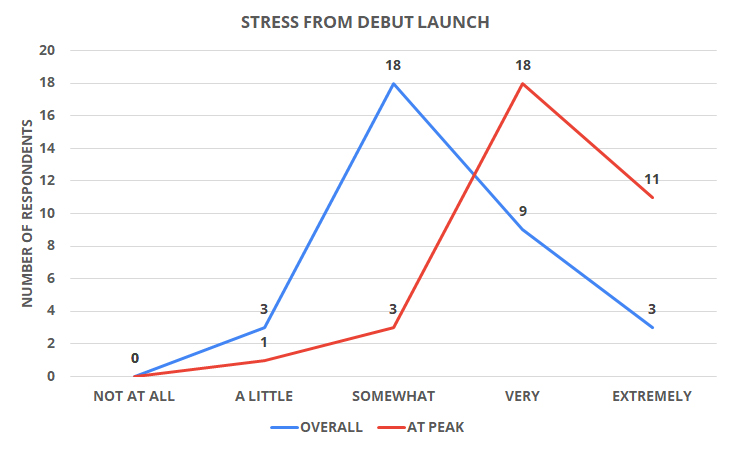
Every single respondent reported some stress associated with their debut. This is normal, per the first paragraph of this page: when you care about something, it causes stress. The average level of overall stress was “Somewhat” and the average peak was “Very,” confirming that stress fluctuates throughout the months leading up to and including debut day. Medians were the same as the means.
In short answer, respondents shared a range of situations and circumstances leading up to their launch day. Some were described as fairly common (though distressing), while other situations seemed relatively unique, yet were experienced by multiple people.
COMMONLY DISCUSSED SITUATIONS
- Anticlimax of relatively quiet launch day after previous over-activity
- Overwhelm of busy launch day, “sheer volume of people trying to talk to me on release day”
- Ghosting or minimal response by publicity team, editors, etc. “surprised by my acquiring editor’s continual failures to meet deadlines,” “after a long professional career, the poor quality of communication between publisher and author was a big surprise, and it felt (and still feels) like a way to emphasize/entrench the power imbalance,” “two months prior to my release date were awful for me, mental-health wise […] publisher wasn’t doing anything, I had no information”
- Editor leaving the publisher affected multiple debuts and authors had to build relationships with the new editor
- Juggling day job, school, family, etc. (“graduate school”) with publishing activity (e.g., e-mails, edits)
- Marketing obligations with or without publisher support (e.g., interviews, quick responses to fans, making posts, contacting influencers), exacerbated by social anxiety, lack of practice, or introversion. For example, “keeping my brain ‘on’ for interviews, […] and being socially ‘on’ for networking […], meeting readers and for signings, was incredibly exciting […] but in retrospect, without enough time to recharge in between, both draining and damaging,” “Really worried about so many things that ultimately didn’t matter, like social media”
- Financial pressures, such as earning out, publisher expectations and potential negative consequences
- Subrights (apparent inactivity from publisher or other concerns) after initial deal
- Unprofessional, unlawful, or bizarre systemic problems/errors (e.g., not appearing on sales lists, not receiving pass pages/ARCs/etc.)
- Checking behavior: “obsessively checking their social media,” “I have OCD, and was diagnosed as such a little before COVID [… therefore] I did actually know what was happening and was able to manage it,” “I developed certain rituals (checking review websites daily, checking metadata, etc) that became nearly obsessive, and it took a while to figure out how to detach myself from it”
- Uncertainty about future author career
- Vague, amorphous dread NOT triggered by specific events or fears
‘UNUSUAL’ SITUATIONS
Respondents described lots of ‘weird’ and seemingly extraordinary situations which, ultimately, may not be so extraordinary after all. These have been separated out for easy reference, should future debuts wonder if they are alone. Minimum of TWO respondents shared EACH of these:
- Major or life-threatening illness such as cancer
- Pregnancy
- Debut group conflicts exposed to national news and/or far-reaching social media (concerns about being ‘canceled’ may fit here)
- Time pressure to personally compensate for team delays: “if I don’t send this email today, my editor will take a month to get to it and the deadline is in 2 months so if I forget to email in two weeks it might be too last minute”
- Negative reviews as marginalized author: “pressure to have a good book as a BIPOC author knowing I will get more criticized than my white counterparts in reviews,” “criticizing aspects of my book very close to my heart regarding marginalizations I share”
- Systemic bigotry as safety concern during publicity events, the burden of problem-solving and getting support
- Excitement and anticipation ONLY (minimal negative stress, mostly positive)
- Transferring from indie publishing may have involved changes for better or worse, such as having more sense of control or less burdensome responsibility
Some mentioned being armored by good self-esteem and empowered by experiences at other demanding jobs. However, many were “shocked” by what appeared to be lower standards of professional behavior in publishing compared to other industries.
Regardless, ‘knowing what to expect‘ from the worst case scenarios seems to be a protective factor shared by many who experienced less stress. Separating personal from public identity is another shield.
I know better than [to] conflate work with self-worth. I am proud of my art, that’s something precious and robust within myself. But once I’ve sold my art and put it out in the world, I accept (without rancor) that readers will love or hate the book as per their prerogative. That’s the business deal I signed up to, eyes wide open.
“Janet,” author
IV. INDUSTRY TRANSPARENCY ISSUES
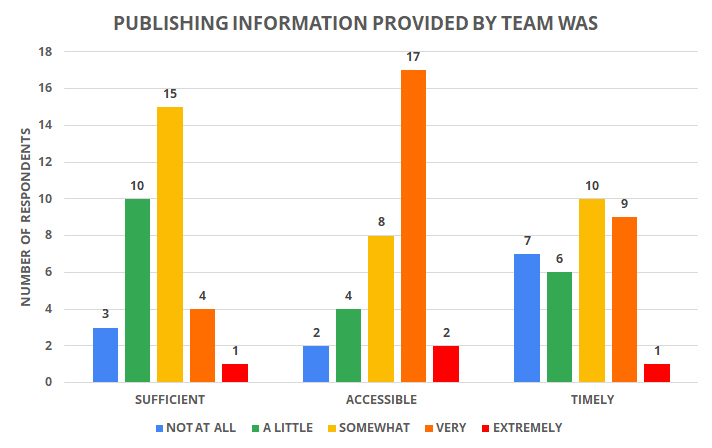
Most reported some problems with transparency from their team (publisher, agents, etc.) about the publishing process as they went through it. On average, information provided was “Somewhat” sufficient (same median), “Very” accessible (median is “Somewhat”), and “Somewhat” timely (same median).
The terms were defined as:
- Sufficient: “enough detail,” covering basic questions, foundational understanding
- Accessible: “understandable” and/or obtainable given the technology, tools, layperson knowledge, and disabilities or neurodivergence
- Timely: “not last minute or delayed”
It’s kind of strange. They expect you to know everything and never explain unless you ask. But sometimes you know so little you don’t even know what to ask.
“Brianna,” author
Worth noting, those with no or minimal delays (including pre-published authors) sometimes felt guilt about their relative advantages.
Most authors tried to be compassionate and understanding of the limitations of their team and reasons for transparency problems. Many observed their teams, especially in the publishing houses, were “overworked,” “underpaid,” even under-trained or actively experiencing personnel turnover. Nobody attributed hang-ups or problems to malice.
Multiple authors noted:
- Publishing team withholding information to avoid conflict about delays/problems: “Publishers need to [… be] honest about what the author will or won’t get,” “My team also seemed reluctant to tell me when things I thought were getting done, in fact weren’t getting done. I don’t know if this was from a lack of willingness to disappoint me, or just simply bad communication.”
- Good, responsive communication from editors and/or publicity team, sometimes complete with “detailed timelines,” documents, and Q&A
- Official-looking but useless documents, lacking substance and meaningful details for the launch
- Incorrect or explicitly false information from publishers, including …
- Marketing plans fell through: “questions about[…] marketing plans and foreign rights and audiobook production […] completely ignored felt very disrespectful,” “If I’d been told from the beginning I would get no publicity or marketing support, I would have done my own promo,” “publicist […] made huge promises that were not followed through on”
- No information about sales even months after the debut, after repeat inquiries
- Disruptive ‘last minute’ issues including “copyedits at the same time as line edits and the deadline was like 2 weeks,” “found out about book promo or interviews she needed the day of,” “we want to do a cover reveal TOMORROW,” “a deadline that seemed either short, arbitrary, or both“
- Reliance on fellow authors: “I found a lot more about the publishing process from other authors than my publishing team,” “They expect you to know everything and never explain unless you ask. But sometimes you know so little you don’t even know what to ask.”
Strategically, some were able to get information from an unresponsive editor through a responsive agent.
Taking a long retrospective view, one respondent shared:
Years later, I can say it was a perfectly average debut that set a solid foundation for my future work. At the time, I felt like a colossal failure and that my career was [dead on arrival].
“JAMISON,” author
While no other author remarked about their launch going ‘better in hindsight,’ this was implicitly reinforced throughout the survey by several authors.
V. SPECIFIC IMPACTS ON FUNCTIONING
THOUGHT PATTERNS
This section started by asking about common ‘thinking traps,’ exaggerated, negative patterns of perception. All were found to be common. Notably, all but one person experienced ‘upward comparisons,’ a disproportionate number at extreme levels (36%). In contrast, more people avoided the other distortions and their extremes.
On average (mean), authors “Somewhat” engaged in self-blame for publishing setbacks and imposter syndrome, while “Very” much experiencing upward comparisons. Medians were the same as means.
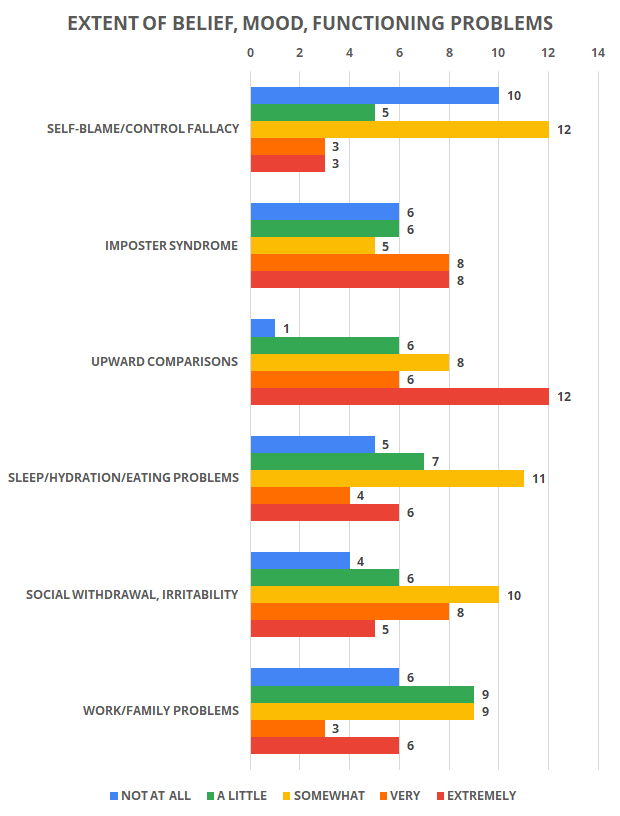
Definitions were offered:
- Self-blame/control fallacy: Belief setbacks were mostly your ‘fault’ (under your control), NOT the industry/situation
- Imposter syndrome: “I don’t belong here,” e.g., in a debut server
- Upward comparisons: to other writers (more “successful,” etc.)
In the short answer section, the survey explicitly asked about the disconnect between intellectual understanding and visceral belief. Ultimately, many respondents acknowledged they still experienced nagging self-doubt and harsh disappointment even when they ‘knew better,’ but acknowledged that knowing better was helpful and thanks to the preponderance of podcasts and other information now available. Hopefully, normalizing and putting a name to this self-contradiction helps in absence of a neat solution.
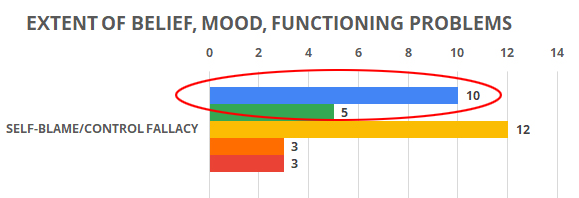
No doubt, the high “Not at all” rates of self-blame are due to writers help writers (and great teams, too). Popular examples include: Publishing Rodeo and Print Run (see more Resources below).
I’ve been on social media and listening to publishing podcasts enough that I know intellectually that a lot of publishing decisions (e.g., in marketing, publicity, etc.) are not my fault, but there’s still a sense of wondering about internal character and personality flaws when things don’t go as expected.
“JAMISON,” author
I still struggle with “there is nothing you can do to meaningfully move the needle on your book’s sales.” I know it to be true, but my past experience complicates that knowing some. My second book was a rare case of my efforts directly impacting the book’s performance – but only because I got very lucky with a motivated and vocal street team who spread the word on my behalf. I have not been able to replicate this with subsequent books /street teams.
“Gale,” author
I thought I should be doing more, but logically knew I had done whatever was possible on my end.
“Vera,” author
Realizing that some blame lay in systemic industry issues, an uninvested editor, and abusive relationship patterns helped me cognitively but did not viscerally relieve my stress levels.
“Leyla,” author
So, rather than believing in my sense of control, acknowledging that there were many things I could NOT control helped me to stay more or less on an even keel. The imposter syndrome will always be there. I’ll always feel like a fraud, and I think there will always be a disconnect between what my head knows and what my worst fears tell me is true. But it helped, too, to have a place where I took note of good things. Kind words from readers, lovely notes, little successes—I think it’s too easy to forget the good things as a debut and instead focus solely on the bad ones (or shift our focus to the next task/the next goalpost we need to reach), and I didn’t want to let myself fall into that trap.
“Selena,” author
If you can see the pattern, it’s a real one! Information and expectation-setting cannot fully alleviate publishing stress, but it was powerful and, I speculate, helpful for later recovery and actually having ‘good moments’ during rough times.
DAY-TO-DAY ACTIVITIES
Authors experienced significant problems with ‘activities of daily living,’ like sleeping, eating, social engagements, and obligations with work, school, etc. On average (mean), respondents “Somewhat” suffered all three types of ADLs: sleep/hydration/eating, social withdrawal or irritability, and difficulty with work/school/family obligations. The medians were also “Somewhat,” suggesting no/few outliers or atypical cases. Several authors reported some issues predated their publishing journey, while most problems were attributed to debut stress.